Can Modern Works of Art Belong to an Older Art Movement
In his painting The Old Guitarist, Picasso fabricated a series of choices to evoke feelings of pity. The guitarist is an sometime man, with grey pilus. The fact that he is seated on the ground suggests that he is playing on the street for spare alter. His emaciated land, torn apparel, and dejected posture show poverty and depression.
Furthermore, Picasso does not simply paint the old guitarist exactly as he would appear in real life; he deliberately distorts or exaggerates certain aspects of the scene in lodge to farther intensify his intended expression. Most obviously, the entire work—except for the guitar—is in blue monochrome. This is clearly unrealistic, simply information technology capitalizes on the melancholy emotional quality associated with that colour.
When we compare Picasso's painting to one of a very similar field of study by Edouard Manet, we can see other strategic formal distortions. Picasso's guitarist is in an improbable (if non impossible) pose that is cramped on all sides by the frame. He looks caged or trapped, where Manet's guitarist, already in a more dynamic pose with his free energy thrusting upward, has room to move inside the frame. Also, where the form of Manet's guitarist flows through organic, rounded curves, Picasso has exaggerated the hard angularity of his guitarist, who appears to be all jutting elbows, ankles, and tendons.
These two works exemplify the difference between naturalism and expression as creative goals. 1 of Manet'southward primary goals was an accurate depiction of the advent of the guitarist, what art historians call naturalism. As to how to feel about him, we are left largely on our own: it is equally probable that a viewer could pity his axiomatic poverty (examine his worn shoes, 5 o'clock shadow, and elementary meal), or admire his bohemian liberty. Picasso, by dissimilarity, paints his guitarist in an expressive manner, explicitly directing our feelings through his stylistic choices.
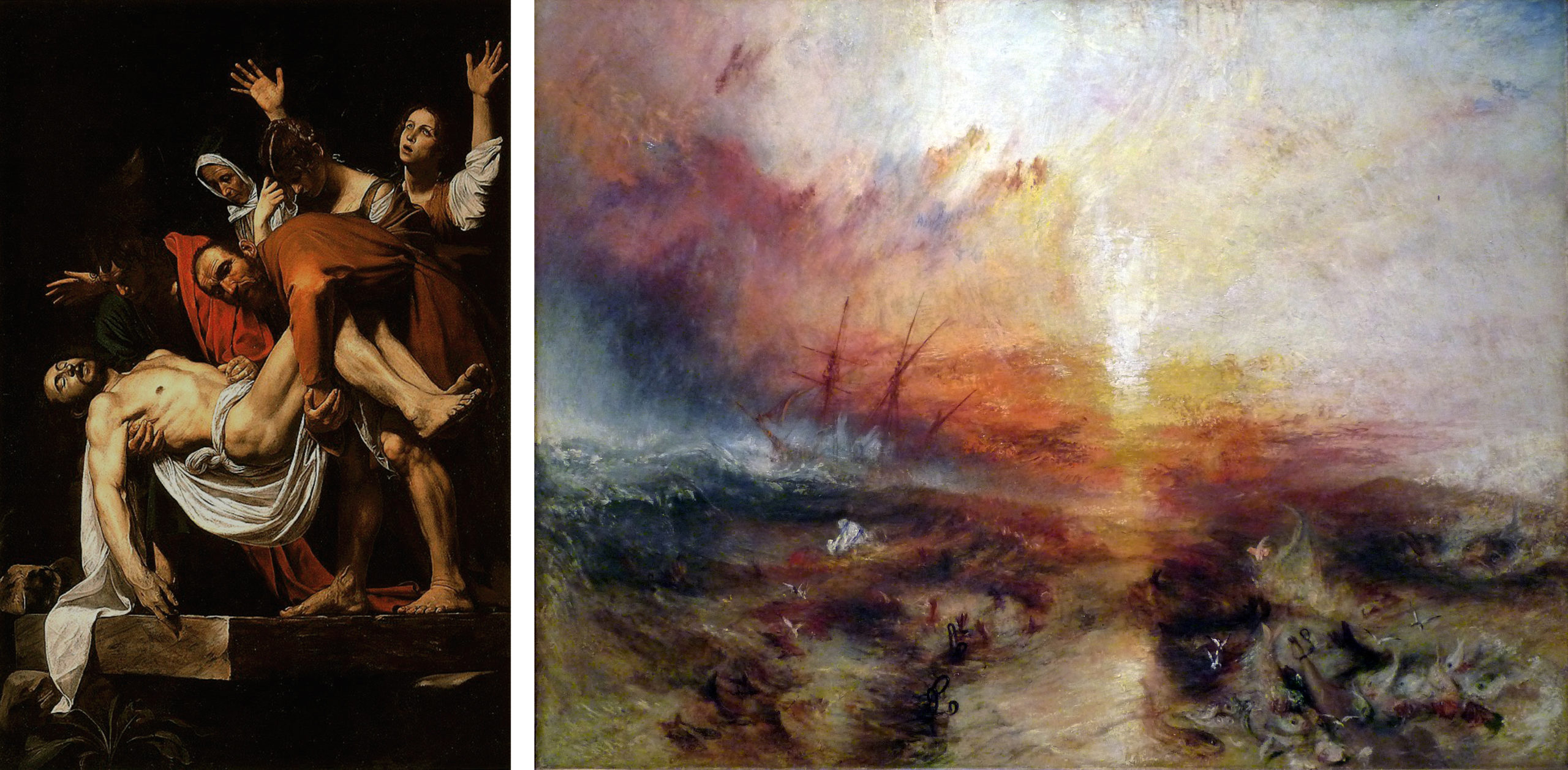
Left: Caravaggio, Deposition (or Entombment), c. 1600-04, oil on canvas, 300 x 203 cm (Vatican Museums); correct: J. M. West. Turner, The Slave Ship, 1840, oil on canvas, 90.8 10 122.six cm (Museum of Fine Arts, Boston)
Picasso's willingness to sacrifice naturalism in gild to enhance the emotional impact of The Old Guitarist is what makes the painting exemplary of modernistic expression. Between the Renaissance and the nineteenth century (with some notable exceptions, such as El Greco), artists would primarily evoke emotions in ways consequent with naturalism.
In his Deposition, the Baroque artist Caravaggio uses spotlighting, gritty earth colors, and trunk language to aid express the emotional drama of the moment Christ's trunk is laid in the tomb, merely zero is as well distorted. The work remains naturalistic; you could run into such a scene in real life. Romantic creative person J. M. W. Turner pushes the boundaries more in his Slave Ship, with plainly painterly brushwork and very intense color, but the painting still looks plausibly like a storm at sea, with the whipping spray and bravado clouds backlit by the setting sun. The Baroque and Romantic periods both emphasized expression as an artistic goal, just both also largely stayed within the confines of naturalistic representation.
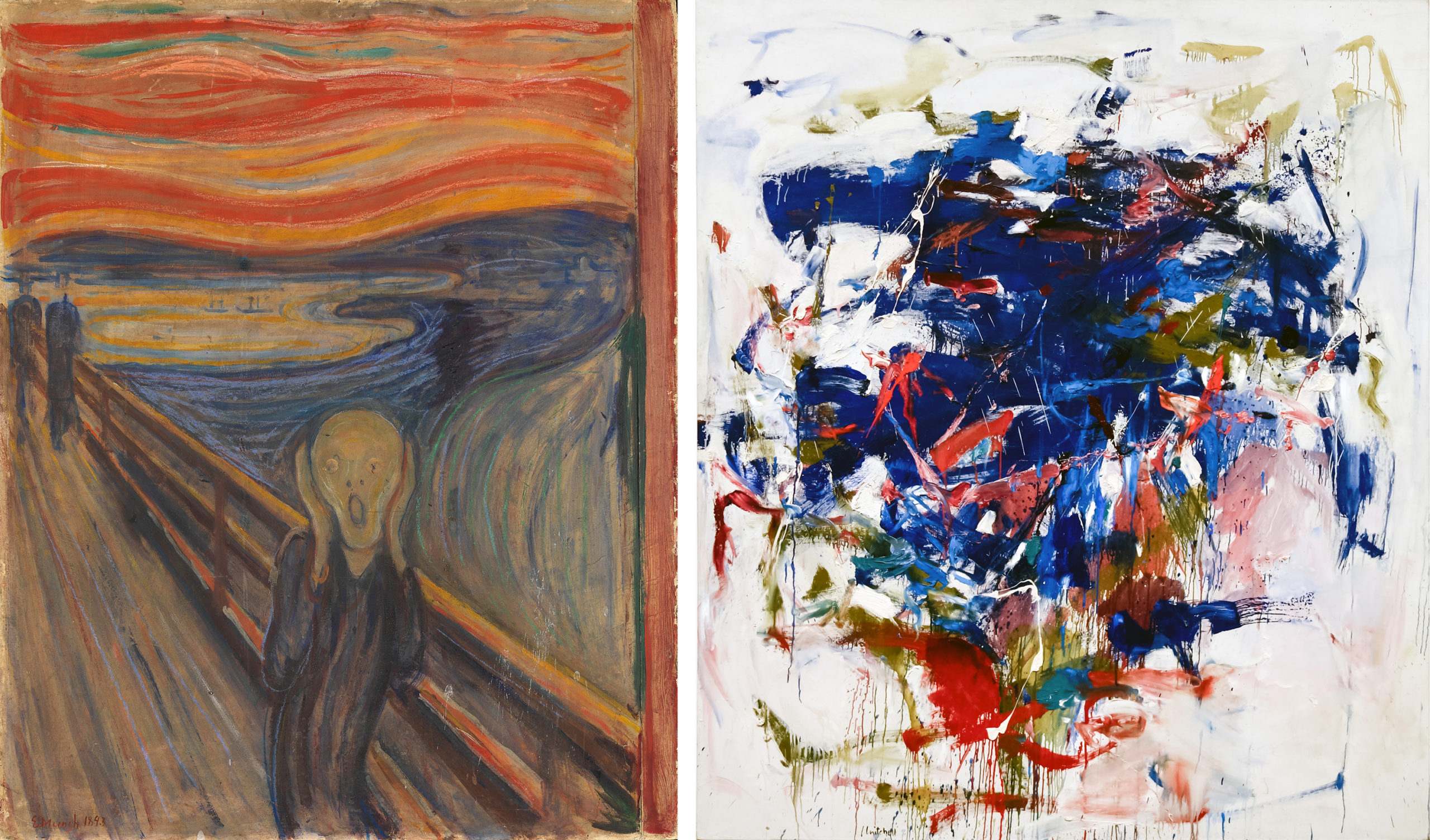
Left: Edvard Munch, The Scream, 1910, tempera on lath, 66 10 83 cm (The Munch Museum, Oslo); right: Joan Mitchell, Stone Bottom, 1960-61, oil on canvas, 198.1 x 172.seven cm (Blanton Museum, Austin, Texas)
Starting in the afterward nineteenth century, the expressionist art movements of the Mod menses were increasingly willing to cede naturalism in pursuit of more powerful expressive effects. Although Edvard Munch's The Scream does include expressive trunk language in the foreground figure, the painting'southward emotional charge is largely carried by its formal distortions. We react beginning of all to the expressive ability of the piece of work's acrid color, vertiginous recession, and nauseatingly undulating composition, which take been exaggerated to the signal where the depicted scene is no longer plausible. Expression has superseded naturalism equally the main aesthetic goal. The Modernistic period saw an increasing recognition of the expressive ability of form — colour, line, shape, composition, and and then on. It is no great conceptual jump from Munch to Joan Mitchell, for whom pure form conveys pure expression, equally the proper name of the Abstract Expressionist movement suggests.
Ex-pression as non-rational
The prefix "ex" ways "out," and so to ex-printing literally means to push out, reconfirming the distinction between expression and representation or naturalism. In the latter, the motive for the work is out in the globe, part of nature, and the artist only re-presents information technology. With ex-pression, the motive for the piece of work is inside the artist, a mental or emotional country, and must be pushed out.
Expression in art history is generally associated with non-rational states of listen. It is not used to describe works that convey objective facts or for ideas arrived at through rational thought processes. In addition to emotions, the term expression is likewise used for works that convey spiritual content, such as Vasily Kandinsky'due south apocalyptic paintings of the 1910s, and hidden content, such every bit the Surrealist André Masson'southward automated drawings of the 1920s.
Because it pertains to non-rational states of mind, expression is often associated with spontaneous or even involuntary creative processes, both mental and manual. While naturalistic art is more often than not acknowledged to crave intensive training, the skills associated with expressionist art are frequently said to exist innate. Correspondingly, rapid or unrefined execution is frequently taken equally a sign of expressive intensity, as though the artist's hand were responding in automatic synchronization with the outpourings of the emotions or unconscious. This is not a universal stylistic characteristic of modern expressionist fine art, just it is common, equally the examples above of Turner, Munch, Mitchell, Masson, and Kandinsky all demonstrate.
The stereotype of the expressionist artist
In that location is a stereotype of the expressionist artist that — not coincidentally — matches the qualities associated with expressionist fine art: almost pathologically irrational, careless of social conventions, and spontaneous to the point of being out of control. It seems that in order to express intensely, the artist has to live intensely. Many analyses of The Old Guitarist begin with the story of Picasso'southward own adversities at the fourth dimension, when he was living in poverty in Paris and had just lost a close friend to suicide. Like stories of the Post-Impressionist Vincent van Gogh's madness, the German Expressionist Ernst Ludwig Kirchner's wartime trauma, and the American Neo-Expressionist Jean-Michel Basquiat'south life on the streets are often used to validate the expressive actuality of their fine art.
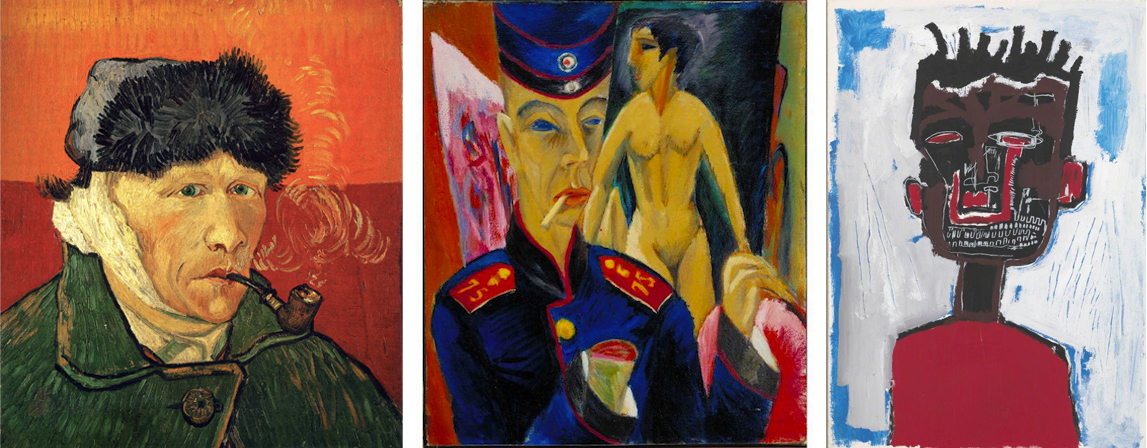
Left: Vincent van Gogh, Self-Portrait with Bandaged Ear and Pipage, 1889, oil on canvass (The Courtauld Gallery, London); center: Ernst Ludwig Kirchner, Self-Portrait as a Soldier, 1915, oil on canvas, 69 x 61 cm (Allen Memorial Fine art Museum); right: Jean-Michel Basquiat, Self-Portrait, 1984, acrylic and lipstick on paper, 98.seven 10 71.1 cm (Gagosian)
We need to maintain a distinction between expression and self-expression, yet. The term self-expression is reserved for works whose primary intent is to communicate something about the artist him- or herself. Well-nigh modern expressionist art had a broader goal than this. Even when modern artists drew from their own experiences, the intent was to create works that express something near the order or culture of their time, or about the wider human condition. Truly cocky-expressive works are of limited relevance to outside viewers; this is why fine art historians typically try to relate works to issues across the personal biography of the artists who created them.
Not all modernistic fine art is about expression
The concept of expression and the stereotype of the expressionist artist are probably the virtually commonly evoked justifications for modern art in the popular agreement. If the work does non look like reality, many people presume that information technology is considering the artist was trying to express something, rather than depict something. Notwithstanding, expression of non-rational mental states is only 1 potential goal of fine art, and although it was a particularly prominent goal during the modern period, it is not the simply motive for non-naturalistic art. We explore other broad answers to the question, 'Why doesn't modern art look similar reality?' in the essays The ambiguity of "realism", Formalism I, and Formalism II.
Cite this folio as: Dr. Charles Cramer and Dr. Kim Grant, "Expression and modernistic art," in Smarthistory, June 16, 2020, accessed April 28, 2022, https://smarthistory.org/expression-modern-art/.
Source: https://smarthistory.org/expression-modern-art/
0 Response to "Can Modern Works of Art Belong to an Older Art Movement"
Post a Comment