Reading With Your Child at Home Tips
Strategies every parent needs to know
The post-obit strategies work for young children through to adults. The only difference is the book choice of the reader.
These strategies are useful when children choose books beyond their instructional levels. They choose books they want to read but every bit all the same, cannot read them independently. Before introducing these strategies, it is ever all-time to allow the reader to read for a few minutes while monitoring the miscues. After a few minutes of reading aloud, and when a pattern in the miscues indicates that significant is lost and reading is laboured, show the reader any of the following strategies. I usually introduce echo and shared together and then inquire the reader to cull. These strategies are not hierarchical. They all offer layers of support to give the reader access to the book of his/her choice. Retrieve, the reader e'er holds the book.
Repeat reading
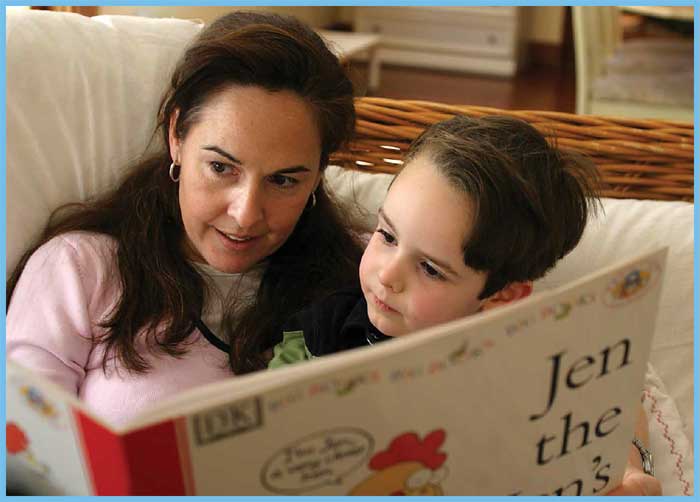
Echo reading is just, parent reads a sentence, paragraph or folio (depending on the text) and the child repeats it back. Before starting, negotiate with the child to read a sentence, paragraph or page. The parent reads first. The child re-reads (echoes) the sentence, paragraph or folio. Keep in this way to complete the book. Repeat reading eliminates the frustration and anxiety that is besides often associated with reading aloud. It often happens that one time the kid becomes confident with the book, author'south style, and language, he or she does not terminate for the parent to take a turn — ultimately, that is the goal — independence. If it does not happen that the kid takes over, echo reading is effective. By 'echoing' your reading, the kid has an opportunity to sound similar a fluent reader. This is important in building a kid's sense of what it feels like and sounds like to be a good reader. The child feels confident, relaxed and enjoys the experience. It is well-nigh comprehension and having fun with a good book. During echo reading, parents model good reading. When parents miscue, they share the feel. This allows the child to encounter that all readers make miscues and self-correct.
Shared reading
With shared reading, the parent reads, the child reads. They accept turns to read. The parent negotiates with the child to read a sentence, paragraph or page depending on the book. When the parent reads, any loss of meaning, misunderstandings or mispronunciations that have been made by the kid are rectified without drawing attending to the child's miscues. When the child comes to unfamiliar words, he/she will hear it read correctly past the parent and will automatically self-correct the side by side fourth dimension the word appears. Shared reading ensures that comprehension is maintained. Shared reading eliminates the frustration of reading because the parent is a partner in the reading of the selected text.
Neurological Print Method (NIM)
The kid reads aloud 'mimicking' the words of the text every bit the parent reads aloud. The child reads a couple of words behind the parent. The parent tracks with a finger and so the child can continue up. It is important to avoid word pointing – instead, the parent's finger moves beyond the line in a fluid motion. The simply reason, the parent tracks is considering children get distracted and when they drop back into the reading, they know where the parent is reading. The parent reads at a normal reading pace. When the child looks away from the book, the parent does not finish reading. Continue with enthusiasm and the child will return to the book. When using NIM, the child has an opportunity to sound like a fluent reader. This is important in building a kid'southward sense of what it feels like and sounds like to be a skilful reader. The child sounds like a fluent reader and builds confidence and trust. In that location is no stress and angst.
Paired reading
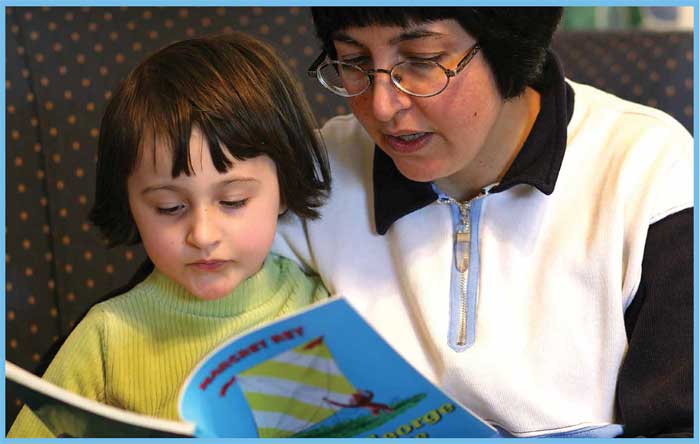
Paired reading is an effective support for readers who ignore punctuation, read in a monotone, and/or extremely speedily or slowly. It is besides a good strategy when children choose to read their favourite book for the 55th time. But read it together and dear it 1 more time. Paired reading is simply reading together at the same stride and in the aforementioned place. The parent reads in a normal reading voice. It usually takes a couple of sentences for both readers to fall into sync. It is like dancing with a partner and it might experience a little awkward until a common rhythm and rhyme are reached. The child holds the book, turns the pages and enjoys the fourth dimension together.
Learning to write
What we need to know
Children experiment with writing long before they kickoff school. Their early squiggles and drawings are the kickoff of writing.
Books provide a powerful model of what writing looks like. Books convey the understanding that squiggles on a folio convey a bulletin. Reading and writing with your children helps them to make sense of how written linguistic communication works.
We learn to write past writing. Children love to write! In classrooms, children are encouraged to select topics that express their ideas and interests. It is hard (sometimes impossible) to write about unfamiliar topics or topics that are irrelevant to our life experiences. Earlier writing, talking about a topic is a practiced place to collect thoughts and ideas.
When children write and freely express their ideas, this is called draft writing. Children demand many opportunities to express their thoughts and ideas in writing without being concerned about the mechanics of writing such a spelling, punctuation and grammer. At this stage, worrying about spelling, punctuation and grammer can hinder their styles, expressions and exploration of words that all-time communicate their ideas. In fact, this level of response often 'kills' off the writer who learns to write less and take fewer risks. Instead, respond to the ideas of the writer – for case, ask: Where did you go your thought? Are yous writing a factual text (poem, recipe, chapter book etc)? Westchapeau is going to happen side by side? Read me your lead sentence once more because that really had me interested in your story. What is going to happen to your main graphic symbol?
If the draft writing is to exist shared with a wider audience, and has been edited for meaning, the side by side stage is to proofread for spelling, punctuation and grammatical mistakes. Not all writing needs to be edited. We do not edit our shopping lists, diaries or reminder notes! Children need to be encouraged to write for enjoyment and play with words.
In classrooms, children explore writing equally a process from drafts to published pieces. Children are encouraged to write for real purposes and utilise a range of different text types such as recipes, factual texts, notes, report writing, narratives and poesy. They are also taught to consider how to appeal to different audiences.
Handwriting should not be confused with writing. Handwriting is a surface characteristic of writing and children who are self-conscious of their handwriting do good from opportunities to write and draw with a multifariousness of pens, textas, paint, magic boards, chalk and 'fancy' pencils. When it comes to publishing, children often publish on the calculator, employ vocalism to text recognition or publish in a variety of means such a poster, alphabet books, dioramas, or affiliate books. The class the publishing takes is the all-time match for the type of story beingness told.
Work that comes home from school may non have every spelling fault corrected, every grammatical mistake rectified or punctuation inserted. It is important to talk with your children about the purpose of the piece of work and what they learned, rather than emphasise the errors. Ask 'tell me questions' such as: 'Tell me about this work …' 'Tell me how you did this …' 'Tell me what you liked almost this activity.'
Source: https://www.petaa.edu.au/w/teaching_resources/parents_guide.aspx
0 Response to "Reading With Your Child at Home Tips"
Post a Comment